
 Due to a technical problem, our website is only available to a limited extent. This also affects our download service area. We are already working on the solution and ask for your understanding.
Integrated inductive encoders for motors
Space-saving and maintenance-free solutions with high robustness for precise angle and position measurement
Integrated inductive encoders from Kübler reliably and precisely detect angular and rotational movements—even under the harshest conditions. Thanks to their inductive measuring principle, they are particularly resistant to dust, oil, vibrations, and moisture. This makes them a maintenance-free, space-saving solution for compact drive systems where precision, robustness, and durability are paramount . Ideal for machine builders and plant operators who require the highest measurement accuracy with minimal space requirements.
Integrated inductive encoders for motors
Space-saving and maintenance-free solutions with high robustness for precise angle and position measurement
Integrated inductive encoders from Kübler reliably and precisely detect angular and rotational movements—even under the harshest conditions. Thanks to their inductive measuring principle, they are particularly resistant to dust, oil, vibrations, and moisture. This makes them a maintenance-free, space-saving solution for compact drive systems where precision, robustness, and durability are paramount . Ideal for machine builders and plant operators who require the highest measurement accuracy with minimal space requirements.
Advantages

ROBUST
FLEXIBLE
SIMPLE
COMPACT
Integrated encoder solutions with inductive sensors – Design
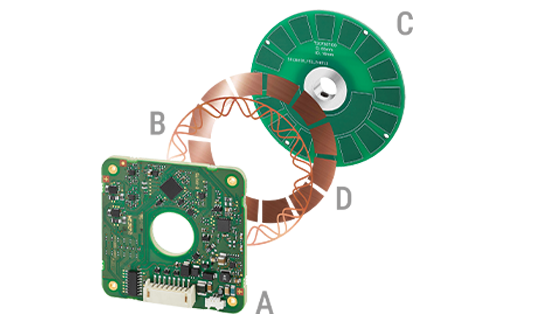
A. Stator board - shape and dimensions can be customized
B. Exciter and receiver coils on stator board
C. Rotor board - shape and dimensions can be customized
D. Measuring scale on stator board - passive element without electrical connection to the stator side
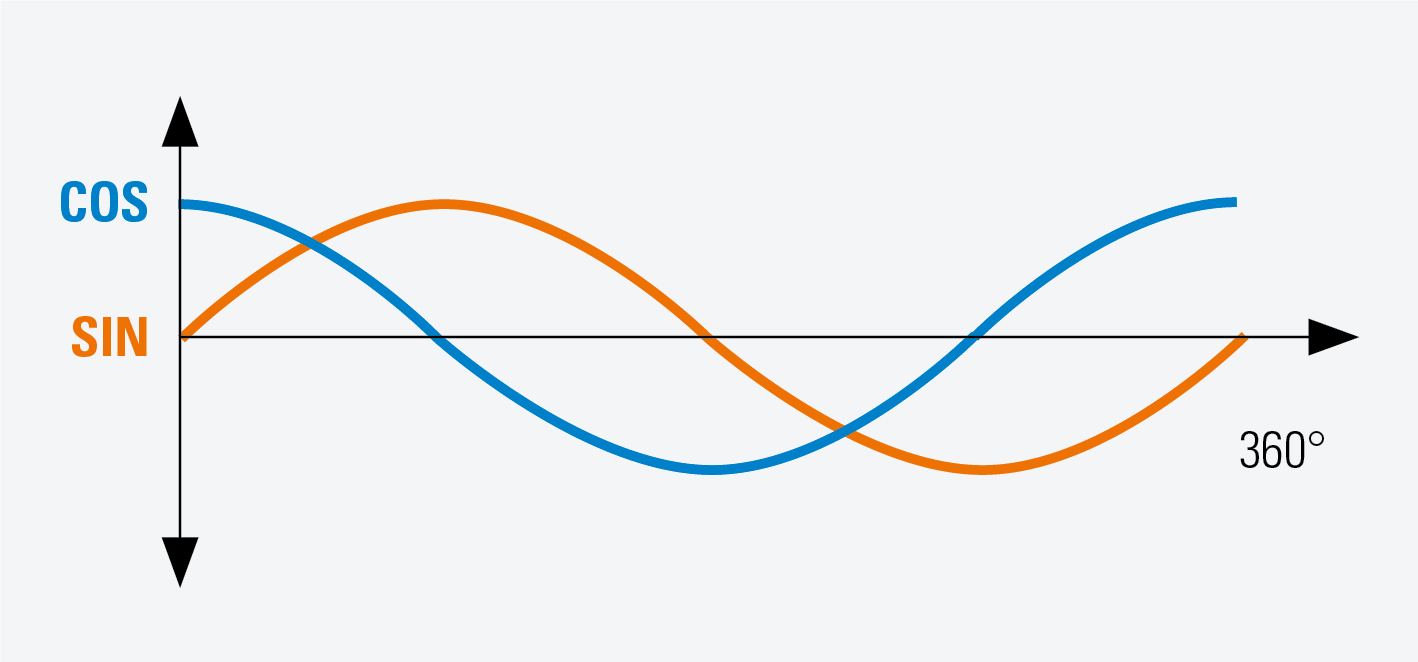
Integrated encoder solutions with inductive sensors - How it works
Inductive rotary encoders work with a high-frequency signal that is influenced by the rotary movement of the rotor. The strength and phase of this signal changes depending on the rotor position. Receiving coils on the stator side record these changes continuously and over the entire circumference.
Sine and cosine signals are generated for each revolution of the rotor, which are converted into exact position values using the arctan function.
