
 Due to a technical problem, our website is only available to a limited extent. This also affects our download service area. We are already working on the solution and ask for your understanding.
Integrated magnetic end-of-shaft encoders for motors
Space-saving and maintenance-free solution for precise angle and position measurement in compact drive systems
Kübler's integrated magnetic end-of-shaft encoders measure the angle of rotation directly at the shaft end. The change in the magnetic field caused by the rotation of a diametrically magnetized cylindrical magnet is used to determine the position. This technology provides a space-saving, maintenance-free solution for compact motor drives that is easy to integrate.
Integrated magnetic end-of-shaft encoders for motors
Space-saving and maintenance-free solution for precise angle and position measurement in compact drive systems
Kübler's integrated magnetic end-of-shaft encoders measure the angle of rotation directly at the shaft end. The change in the magnetic field caused by the rotation of a diametrically magnetized cylindrical magnet is used to determine the position. This technology provides a space-saving, maintenance-free solution for compact motor drives that is easy to integrate.
Advantages of magnetic end-of-shaft encoders

ROBUST
SIMPLE
PRECISE
FLEXIBLE
Integrated encoder solutions with diametrical magnets – Design

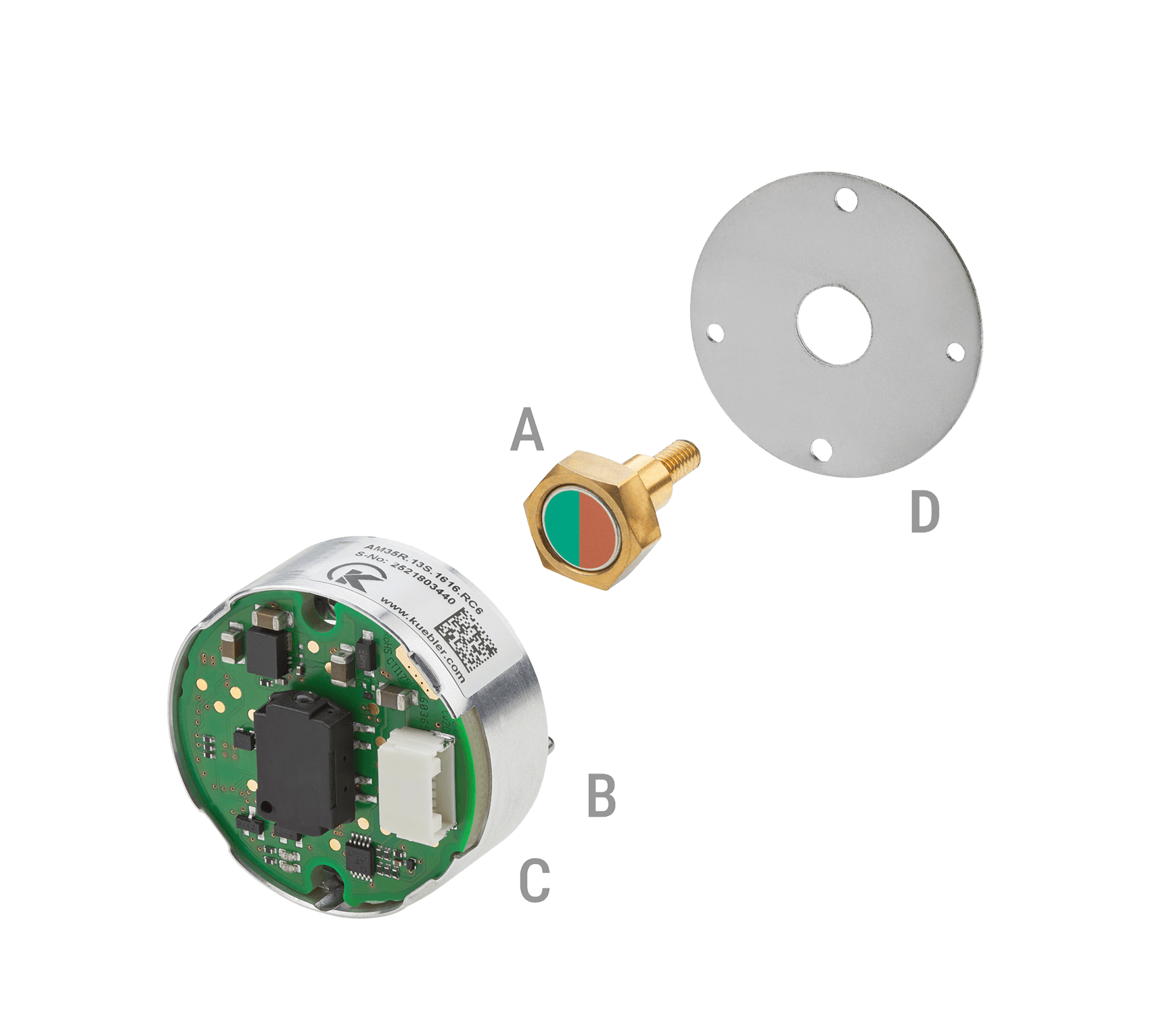
- Diametrically magnetized cylindrical magnet, for mounting on the customer’s shaft
- Magnetic field sensors with digital signal processing
- Energy harvesting technology for multiturn detection
- Shielding plate to protect against magnetic interference fields generated by the motor
(e.g., electromagnetic brake)
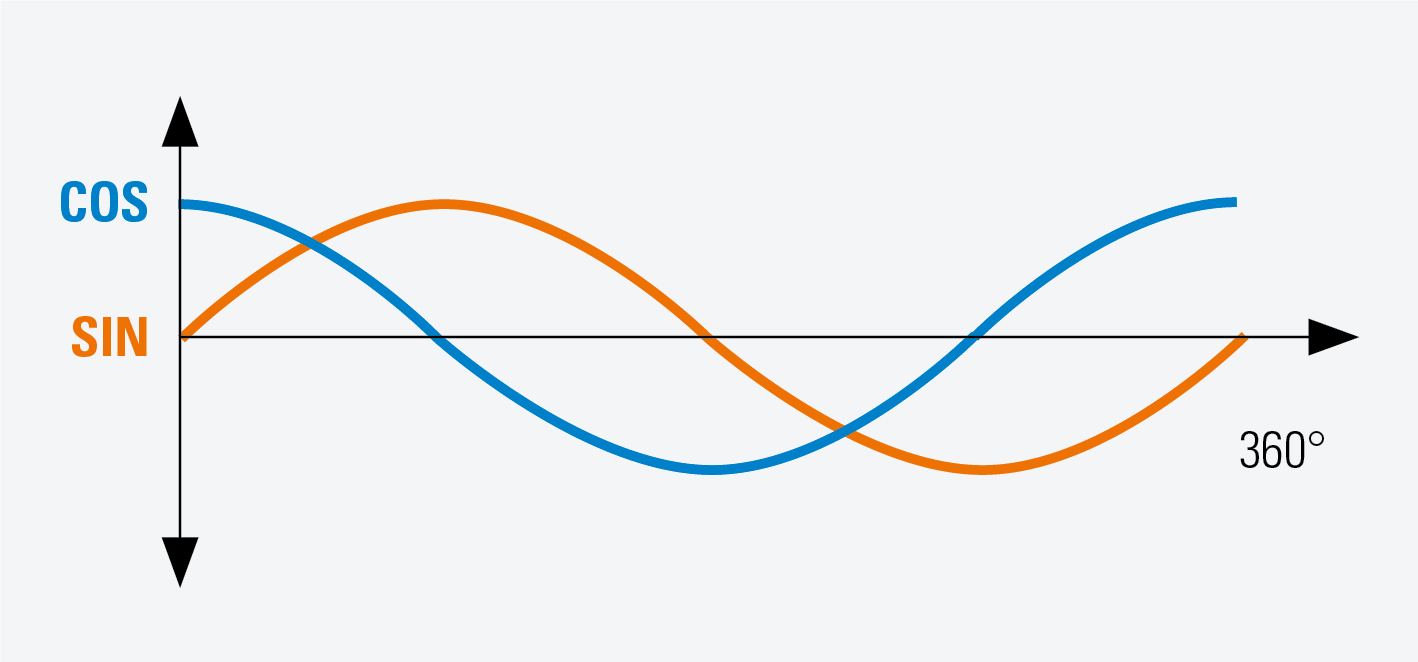
Magnetic Sensors with Diametrical Magnets – How They Work
Inductive encoders operate using a high-frequency signal that is affected by the rotational movement of the rotor. The amplitude of this signal changes depending on the rotor's position. Receiving coils on the stator side continuously detect these changes across the entire circumference.
